


An institution has just announced a new decision. Within hours, hundreds of comments pile up under the post. The top comments are harsh and have thousands of likes. The communications team raises the alarm: everyone is against it. But do social media comments really show public opinion? The short answer: not always. In this post, we explain why and how to read comments well.
In short
Commenters are only a small share of the people who see a post. And within this group, a small minority writes a lot. For example, Pew Research Center looked at US Twitter users in 2019:
10%
the most active users
80%
of all tweets: written by that group
In other words, the most active 10% wrote 80% of the tweets (source). So the comment section often shows the loudest group, not the silent majority. This group matters, but it is not public opinion on its own.
Likes don’t show exactly how many people share a view. There are a few reasons for this:
As a result, the five most-liked comments can look like thousands of views. Yet they may come from only a few people.
You need two questions to measure a narrative. First: how many different people write this view? Second: how much do likes amplify it?
Say a post has 300 comments. The “wrong decision” narrative comes from 40 people but has 2,000 likes in total. The “understandable decision” narrative comes from 90 people but has 150 likes.
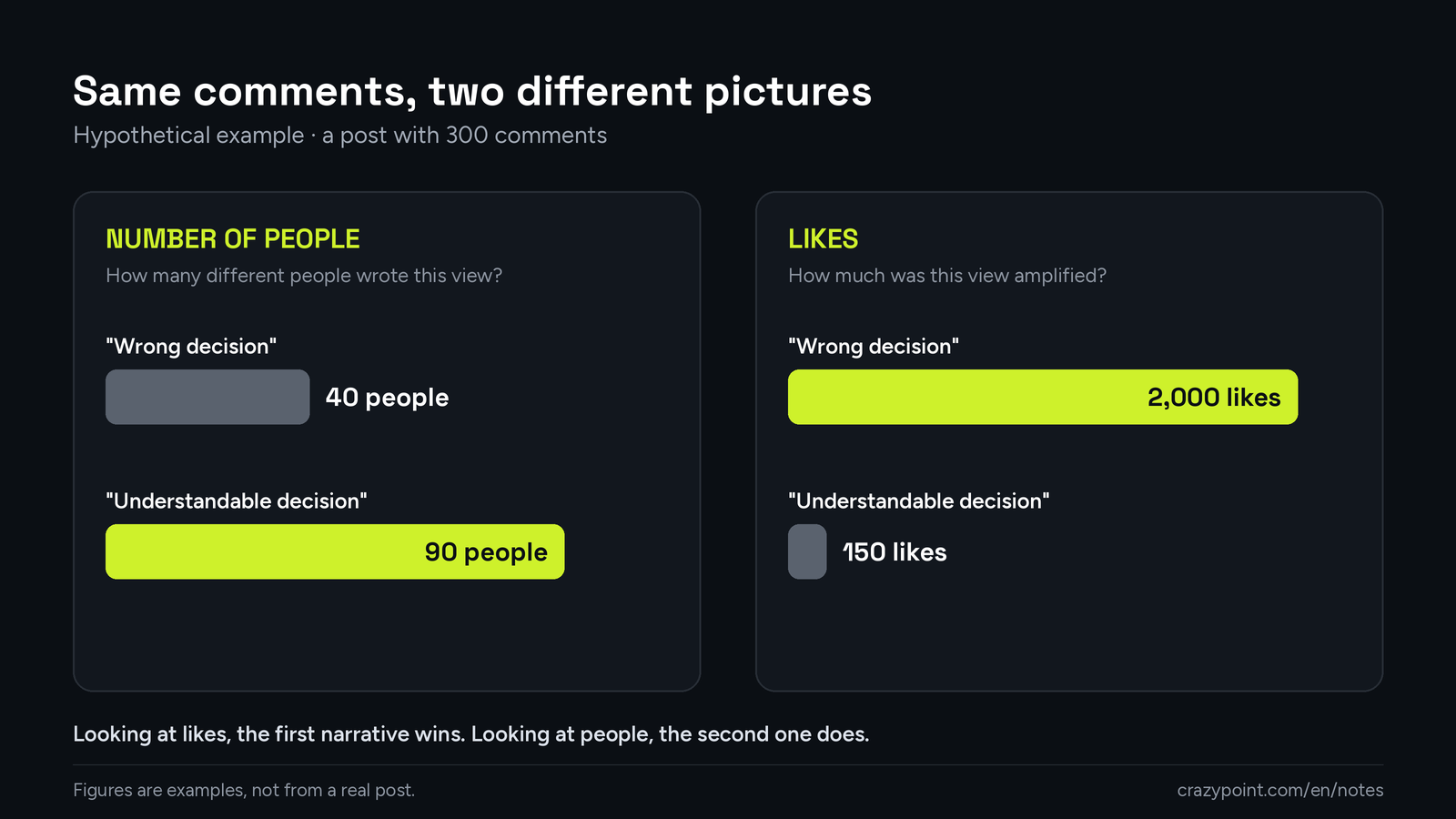
Someone who only looks at likes thinks the first narrative leads. Someone who counts people sees a different picture.
The gap between the two measures is information too. It can show that a small group is amplifying a narrative.
Sometimes a wave of comments doesn’t form on its own. These signs may point to it:
Remember
None of these signs is proof on its own. Real people may share the same slogan too. So read them as signals, not verdicts.
When you look at reactions to a post, these questions help:
The last question is the one most often skipped. A big conclusion from a few comments can be riskier than not looking.
Answering these questions by hand takes hours. That is why we built Tepki Terminali. Tepki Terminali analyses the comments on a post on X, Instagram and TikTok. Agenda analysis currently runs on X.
It measures how many people a narrative comes from and how much it gets amplified.
It counts one person’s repeated comments once. It flags posts with the same text as a signal.
It calculates every number with counters. If the data is not enough, the report says so clearly.
It only uses public posts and comments. It doesn’t access private accounts or messages.
Tepki Terminali is built for institutions. Public communication units, agencies, brand teams and party digital teams are a few of them.
Let’s talk about Tepki Terminali for your institution
Let’s find the right package for your institution together. Want us to run your social media accounts too? See our Social Media Management page.

Comments are closed